
NASA’s Moon Base program marks a strategic inflection in U.S. lunar policy: a deliberate shift away from discrete, mission-by-mission exploration toward the construction of a permanent, crewed outpost at the lunar South Pole. The most consequential structural signal is the agency’s decision to deprioritize the Gateway orbital station and redirect its resources, personnel, and existing hardware toward the surface, a reallocation that concentrates near-term funding on precisely the surface transportation, infrastructure, power, and communications capabilities that commercial providers are being asked to supply. The program is organized into three phases of escalating cadence, mass, and complexity, and the accompanying roadmap frames a combined public investment of at least $30 billion across roughly a decade (2026–2036): approximately $10 billion in each of Phase 1 and Phase 2, and $10 billion-plus in Phase 3.
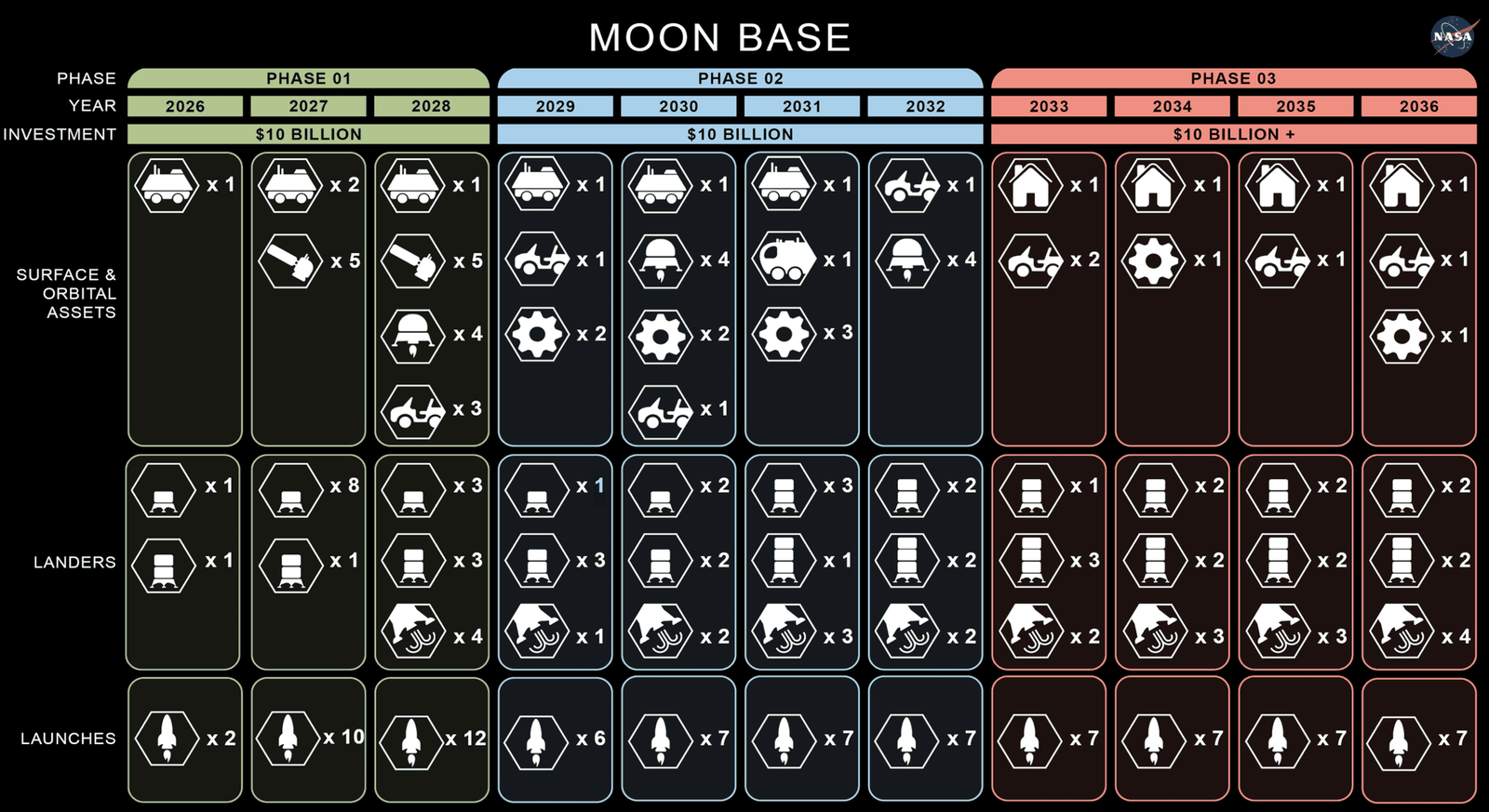
The phased architecture scales aggressively. Phase 1 (“experiment and learn,” 2026–2028) targets up to twenty-five missions including roughly twenty-one landings delivering about four metric tons of payload to the surface, alongside two lunar orbital communications constellations and early “survive-the-night” radioisotope demonstrations. Phase 2 (“early habitation,” 2029–2032) raises delivered cargo to as much as sixty metric tons across up to twenty-four landings, increases CLPS lander payload capability to five metric tons, and introduces solar and early nuclear surface power, permanent surface communications, lunar PNT, and the first habitation and pressurized-rover elements. Phase 3 (“sustained presence,” 2033–2036) scales delivered mass to roughly 150 metric tons, on the order of thirty-eight metric tons per year, lifts CLPS payload capability to eight metric tons, and brings an operational fission surface power station, high-throughput surface communications, habitats, in-situ resource utilization, and recurring cargo delivery and return online. Across the full program, cumulative demand approaches eighty launches and seventy-plus landings, and hundreds of metric tons delivered to the lunar surface.
For an investor, the important shift is not the headline dollar figure but the change in procurement character. NASA has been explicit that the Moon Base will be built alongside commercial and international partners “at an unprecedented scale,” with multiple on-ramps for new and existing providers, block-buy purchasing of launch and in-space transit capacity, and recurring task orders in place of one-off demonstrations. The Commercial Lunar Payload Services (CLPS) program is being expanded: NASA has signaled it will immediately issue new Requests for Task Order Proposals for Phase 1, release a follow-on CLPS solicitation supporting Phases 2 and 3, and stand up a heavier next-generation CLPS 2.0 vehicle, with requests for information already posted to sam.gov. This converts the addressable opportunity from a series of individual contracts into a multi-year, multi-award pipeline of recurring surface services, the demand profile that most benefits an incumbent with fielded hardware.
The Moon Base program is therefore best characterized as a structural tailwind rather than a booked catalyst. Very little of the multi-phase opportunity is yet under contract; the roadmap’s cadence and funding depend on annual appropriations, and NASA’s own materials acknowledge supply-chain, test-facility, and technology-maturation constraints that make the aggressive timeline uncertain. If the program is funded and executed at anything approaching the articulated scale, it would support a recurring, multi-year pipeline of lunar surface services across a $30 billion-plus build-out, a shift from episodic missions toward sustained commercial demand.
| Phase 1 (2026–2028) | Phase 2 (2029–2032) | Phase 3 (2033–2036) | |
|---|---|---|---|
| Investment | ~$10B | ~$10B | $10B+ |
| Objective | Experiment & Learn | Early Habitation | Sustained Presence |
| Surface Payload | ~4 tons | Up to 60 tons | ~150 tons cumulative (~38 tons/year) |
| Landings | ~21 | Up to 24 | Recurring |
| Power | RHUs, demos | Solar + reactor demo | Operational fission power |
| Communications | Relay satellites | Permanent surface comms | High-throughput networks |
| Mobility | Rovers, hoppers | Pressurized rovers | Logistics fleets |
| Habitation | None | Initial modules | Semi-permanent habitats |
| ISRU | Research | Demonstrations | Operational systems |